A possible route
MoSA Guide to Starting a Restitution Process
Is something from your community far away?
Perhaps there is a name, a photograph, or a story. Perhaps we know that there are ancestors far away, but not where. Or a search in a museum catalogue has just revealed something we had never seen before. We can begin there.
This guide emerged in Rapa Nui, from processes to bring back cultural heritage and ivi tupuna (ancestors) separated from their territory. It shares questions and tools that may be useful elsewhere without erasing the authorities, memories, spiritual relationships, and conflicts specific to each people, without presenting Rapa Nui as an interchangeable example or proposing a universal method.
Museums often present restitution as an administrative procedure: first the form, then the evidence, the assessment, and perhaps the return. For MoSA, the process begins earlier: with a relationship, an absence, and a history of separation.
We know that not everything held in a museum left in the same way. There were lootings, excavations, exchanges, sales, gifts, and scientific appropriations. But these actions did not take place on neutral ground. They occurred within colonial relations shaped by violence, evangelisation, cultural hierarchy, unequal resources, and different forms of imposed authority.
MoSA uses the word ‘stolen’ as a political position in relation to this history, not as an identical legal conclusion for every case. A receipt, a donation, or a permit recorded by an expedition does not in itself resolve the question of consent or turn colonial extraction into an exchange between equals.
The institution holds inventories, laws, governing bodies, and documents that can enable or block a return. Understanding that system makes it possible to intervene in it. But its categories do not determine what or who is being claimed, who maintains a relationship with them, or what it means to care for them. The relationship comes before the case file.
To begin
Write down what or who is far away and what we know so far. A name, a photograph, or a memory is already information.
Search for where they are or ask an institution what it holds from our territory or community.
Speak with those who have a relationship, responsibility, or authority over their care and future.
Everything does not need to be resolved before taking the first step.
The route changes
Cultural heritage and ancestors are not the same
This difference changes the route.
Cultural heritage
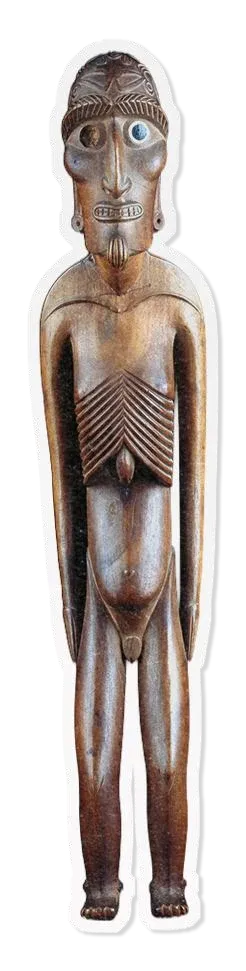
It may be a ceremonial figure, a sculpture, a tablet, a photograph, an archive, an everyday item, or another cultural entity that is far from the community with which it maintains a relationship.
In Rapa Nui, where appropriate, we can also speak of ta‘oa through the relationships and meanings that this word mobilises.
A cultural entity may have been desacralised, turned into a commodity, souvenir, or ethnographic piece. It may also acquire new spiritual, political, and community relationships. Its meaning did not stop at the moment it left.
In these processes, provenance, custody, legal title, acquisition conditions, and legal avenues for restitution may matter. These categories help move the institutional process, but they do not fully define what is being claimed.
Ancestors
Here the route changes. An ancestor is not a collection object or cultural property.
In Rapa Nui, speaking of ivi tupuna restores a relationship that disappears when a person is reduced to “remains”, “anthropological material”, a “specimen”, or an inventory number.
- Who are they, or who might they be?
- With whom do they maintain a relationship?
- Who has the responsibility and authority to decide about their care and return?
- What must happen while they remain far away?
- Not: who owns them.
This route begins from dignity, the rights of Indigenous Peoples, and the authority of descendants and communities. The United Nations Declaration on the Rights of Indigenous Peoples recognises the right to access and repatriate ceremonial objects and human remains through mechanisms developed together with the peoples concerned.
Use the route without losing the relationship
Four movements
01
1. BEGIN
What or who is far away? What relationship was interrupted? What do we know and what remains open?
Start from what we know
A name, a photograph, an expedition, a ship, a collector, an old book, or an oral history can open the search.
- community and institutional names
- memories and accounts
- dates, places, and people connected to the removal
- photographs, letters, publications, and records
- doubts, contradictions, and open questions
The museum’s name may help us locate them. It does not have to tell us what or who they are.
Read the full movement02
2. TRANSLATE
How do we use the institutional system without allowing its categories to define the relationship?
At some point, institutional language appears: inventory number, provenance, legal title, deaccessioning, governing body, export licence, restitution policy. Translating means understanding what the system needs in order to act without allowing that system to define the relationship.
Read the institution
The museum has people, rules, hierarchies, interests, and contradictions. It is also part of a broader legal system, depending on the country or kingdom to which it belongs.
- What actors are involved?
- What rules connect their decisions?
- What procedure does it claim to follow?
- What does it actually do?
- Where does the process become blocked?
03
3. SUSTAIN
How do we keep the process alive without surrendering the mandate or accepting that dialogue indefinitely replaces a decision?
Keep a record
Dates, emails, documents, responses, promises, deadlines, expenses, and changes of contact person make it possible to see where the process becomes stuck. We see that museums often use the idea of “dialogue” to indefinitely replace the decisions and actions requested by communities.
After a meeting, a short summary can establish:
- what was agreed
- who will carry out each task
- what remains outstanding
- the next date
- which interim measures remain in force
04
4. RECONNECT
What do we want to become possible again during the process and after the return?
The institution will speak about packing, insurance, permits, customs, and conservation. There are also other questions:
- Who receives them and where?
- What ceremony is appropriate before, during, and after the journey?
- Who may be present?
- What may be documented?
- What must remain private?
The knowledge accumulated by the institution must also return
The return may include:
Read the full movement01
1. BEGIN
Start from what we know
A name, a photograph, an expedition, a ship, a collector, an old book, or an oral history can open the search.
- community and institutional names
- memories and accounts
- dates, places, and people connected to the removal
- photographs, letters, publications, and records
- doubts, contradictions, and open questions
The museum’s name may help us locate them. It does not have to tell us what or who they are.
Recognise the interrupted relationship
The relationship may be ancestral, spiritual, territorial, familial, ceremonial, cultural, or political. Restitution is a way of recovering the capacity to remember, care, practise, teach, name, and decide.
Recognise who needs to be involved
A process may begin with one person, but decisions may involve different families, authorities, generations, or organisations.
- Who maintains a relationship with what or who is far away?
- Who has responsibility or authority?
- Who must be consulted before an important decision?
- How are disagreements recognised?
- Who communicates and who follows up?
There is no need to unify a “community voice” to make an institution’s work easier. Rapa Nui does not speak with a single voice either. There are different families, generations, forms of knowledge, and positions. Plurality is a legitimate part of the process and does not diminish its legitimacy.
Agree on what is not shared
Not all knowledge should circulate. There may be images, names, places, or spiritual information that belong only to certain people.
- what is shared, with whom, and for what purpose
- what requires additional consent
- what may be shown without being copied or published
- how the process archives will be stored
- what must remain outside the institutional case file
Locate
The catalogue makes it possible to find, but it also shows how the institution classified what it retained.
- the MoSA collection [LINK TO THE COLLECTION]
- museum and university catalogues
- community, national, and institutional archives
- old publications
- expedition journals and correspondence
- collectors’ records
- photographs
- databases
- family memories and oral histories
It is useful to try names, translations, and spelling errors, as well as searching by territory, date, ship, expedition, or collector.
- What does the institution hold from our territory or community?
- What does not appear in the public catalogue?
- What archives, photographs, samples, or data are associated with it?
- What provenance research has the institution carried out?
- Are there earlier inventories or uncatalogued materials?
The holding institution has a responsibility to investigate and open its archives. The history of the collection is not a task that should fall solely on the community.
Define what is being sought now
- accessing information
- visiting a storage facility
- correcting a name or description
- stopping an exhibition or research
- removing images
- identifying samples and data
- transferring legal title
- initiating restitution
- preparing the repatriation of an ancestor
An initial request can be concrete without closing off the final outcome.
02
2. TRANSLATE
At some point, institutional language appears: inventory number, provenance, legal title, deaccessioning, governing body, export licence, restitution policy. Translating means understanding what the system needs in order to act without allowing that system to define the relationship.
Read the institution
The museum has people, rules, hierarchies, interests, and contradictions. It is also part of a broader legal system, depending on the country or kingdom to which it belongs.
- What actors are involved?
- What rules connect their decisions?
- What procedure does it claim to follow?
- What does it actually do?
- Where does the process become blocked?
- Who can change a decision?
- What precedent or exception exists?
This is a form of hacker work: understanding the internal workings of a system in order to find a possibility for intervention that was not anticipated.
Identify who decides
The person answering an email may want to help but have no authority to return anything. Sometimes the decision depends on laws, internal policy, or even institutional customs.
- who holds legal title
- who maintains custody
- who authorises a return
- which body makes the final decision
- which policy, procedure, or law applies
- who funds the research, preparation, and transport
Open a first contact
There is no need to begin with a long case file. A short message can open the investigation:
We are part of [community, family, or organisation] and are researching [cultural heritage / ancestors] connected to [territory]. We found a reference to [name, number, or description]. We request all available information about its provenance, acquisition, current status, and associated documentation, including images, samples, and data where relevant. We also request the name of the person and governing body responsible for restitution or repatriation decisions, together with the applicable procedure. While this conversation moves forward, we ask that [interim measure, where relevant].
If you already have more information, you can follow the [LINK TO THE RESTITUTION REQUEST LETTER TEMPLATE].
Request the complete archive
A catalogue record rarely contains the whole history. There may be:
- acquisition records
- earlier inventories
- travel letters and journals
- photographs
- expedition reports
- previous requests
- scientific studies
- conservation records
- samples
- scans and digital models
- data derived from research
Requesting these archives also restores knowledge.
Build a simple folder
The case can be organised into five parts.
1. What or who is being claimed
Community and institutional names, descriptions, photographs, and inventory numbers.
2. Who is writing and what relationship exists
The territorial, ancestral, familial, ceremonial, spiritual, historical, cultural, or political relationship.
3. What is known
- This is what we know.
- This is what the community remembers.
- This is what the institution says.
- This is what is still unclear.
Documentary gaps are common in colonial contexts. They should not, in themselves, become a reason to reject a return.
4. What is being requested now
Information, access, an interim measure, a correction, transfer of legal title, restitution, or repatriation.
5. What must happen next
A response date, a responsible person, and the next step.
If we are speaking about ivi tupuna
This route begins from another relationship. The central questions are:
- From what place was this person removed, and under what circumstances?
- Are there related descendants, families, or authorities?
- Where are they and under what conditions?
- Have they been exhibited, photographed, or researched?
- Were hair, teeth, tissues, samples, or genetic material removed?
- What images, analyses, and data exist?
- Who holds and uses those data?
- What must stop while the process moves forward?
- What forms of care, access, privacy, or ceremony are appropriate?
Provenance research does not automatically authorise new analyses or the taking of samples.
While ancestors remain in an institution, responsibility continues. Measures may be requested such as:
- removal from display
- suspension of new images or research
- separate storage
- access agreed with the community
- identification of samples and data
- ceremonial preparation before transfer
03
3. SUSTAIN
Keep a record
Dates, emails, documents, responses, promises, deadlines, expenses, and changes of contact person make it possible to see where the process becomes stuck. We see that museums often use the idea of “dialogue” to indefinitely replace the decisions and actions requested by communities.
After a meeting, a short summary can establish:
- what was agreed
- who will carry out each task
- what remains outstanding
- the next date
- which interim measures remain in force
When they say “no”
An institutional response may present a political decision as though it were a technical impossibility.
“The law does not allow us to return it”
Which law? Which specific provision? Who interprets it? What exactly does it prevent? Are there exceptions or precedents?
“There is not enough evidence”
What do they consider evidence? What did the institution investigate? How did it incorporate oral memory and traditional knowledge? What exactly is missing? The absence of documents may be part of the colonial history of the case, not a failure of the community.
“You do not have suitable conditions to care for it”
Who defined those conditions? Are they a legal requirement? Are they applied in the same way to the institution itself? The underlying question remains who has the authority to decide what care means.
“We can offer a loan”
A loan may open access, but it keeps ownership and decision-making within the institution. It may function as a temporary measure. It should not be presented as restitution or used to replace it.
They do not respond
A new message with a specific date, the contact details of the governing body, the institutional policy, a request for access to information, or a connection with other communities may move the process forward. Silence also reveals where power lies.
Build alliances without losing the mandate
Other communities, Indigenous networks, researchers, lawyers, translators, artists, journalists, or people within museums may accompany the process. There is an increasingly visible movement around restitution, and MoSA seeks to connect these forces. You can look for allies in [LINK TO DIRECTORY OF ORGANISATIONS].
It is important that the decision always remains in the hands of those who have a relationship, responsibility, and authority over the process.
Do not freeze the relationship while waiting for the return
A process can take years. During that time, knowledge and memories that form part of the reconnection process can also be recovered:
- archives
- photographs
- names
- access
- encounters
- knowledge
- decision-making capacity
- conversations between generations
04
4. RECONNECT
The institution will speak about packing, insurance, permits, customs, and conservation. There are also other questions:
- Who receives them and where?
- What ceremony is appropriate before, during, and after the journey?
- Who may be present?
- What may be documented?
- What must remain private?
- How do different generations participate?
- Who decides what happens next?
The knowledge accumulated by the institution must also return
The return may include:
- case files
- correspondence
- photographs
- scans
- research
- conservation records
- data
- samples
- reproduction rights
The return opens another stage
The return does not recover an intact past.
A practice, a name, a technique, a story, a spiritual relationship, or a conversation between generations may return. Disagreements and new questions may also emerge.
RETURN → RECONNECT → CARE → TRANSMIT
The question of return is what becomes possible again in a community and territory with that entity back, not only how it returns.
Before sending
- Is it clear what or who is being claimed?
- Does the letter use the names and relationships recognised by the community?
- Did those who have responsibility or authority participate?
- Is knowledge that should not circulate protected?
- Do we know who has custody, who holds legal title, and who decides?
- Have we separated what is known, community memory, the institutional version, and doubts?
- Are the request and the next step concrete?
- Did we request the associated archives, samples, and data?
- Are there interim measures that should be requested?
- Has follow-up been defined?
If this concerns an ancestor: Does the letter speak of a person, their dignity, and their relationships, or does it repeat the language that turned them into a collection?
Where this guide comes from
This guide forms part of a genealogy of experiences around restitution in Rapa Nui and other territories. It does not propose that all peoples follow the same path. What can travel are tools for searching, asking questions, protecting knowledge, reading an institution, identifying where power lies, responding to an obstruction, and keeping one’s own relationship at the centre.
What cannot be generalised belongs to each territory: authority, lineage, memory, spiritual relationships, forms of care, and the specific history of separation. Restitution makes it possible to affirm that museums, relationships, and ways of producing knowledge can be constructed differently.
With the wise collaboration of:
- Leonardo Pakarati
- Paula Rossetti
- Mario Amahiro Tuki
- Amber Aranui
Frameworks and reference figures
There is no single law that resolves every process. The route depends on what or who is being claimed, when and how they left, where they are located, which institution holds them, and which rules apply.
The 1970 UNESCO Convention applies to certain cases involving cultural property, but it does not automatically cover colonial displacements or provide, in itself, a general route for ancestors.
The United Nations Declaration on the Rights of Indigenous Peoples provides a central framework for cultural and spiritual heritage, ceremonial objects, and the repatriation of human remains.
Professional standards and institutional policies may open possibilities, but they do not replace rights, community authority, or the laws applicable to each case.
This guide places the processes and lessons of Rapa Nui in conversation with:
- Association on American Indian Affairs, *A Guide to International Repatriation*.
- United Nations Declaration on the Rights of Indigenous Peoples, especially Articles 11 and 12.
- UNESCO, 1970 Convention and its Operational Guidelines.
- UMAC/ICOM, *Guidance for Restitution and Return of Items from University Museums and Collections*.
- Arts Council England and Institute of Art and Law, *Restitution and Repatriation*.
- *Joint Guidelines for Dealing with Cultural Property and Human Remains from Colonial Contexts*.
- ICOM, *Code of Ethics for Museums*.
- Rapa Nui Museum and the Ka Haka Hoki Mai Te Mana Tupuna Programme.