Ua, Stuttgart — 4567
Imágenes
Origen y lugar de hallazgo
Hecho durante: Mitte 19. Jh.
Registrado en: Linden-Museum Stuttgart · Linden-Museum Stuttgart collection record for Ua, Stuttgart — 4567
Custodia y ubicación informadas
Las fuentes pueden describir custodias o ubicaciones históricas.
Custodia informada: Linden-Museum Stuttgart
Registrado en: Indigen Recollecting Rapa Nui Gallery
Ubicación informada: Stuttgart
Registrado en: Indigen Recollecting Rapa Nui Gallery
Custodia informada: Linden-Museum Stuttgart
Registrado en: Linden-Museum Stuttgart · Linden-Museum Stuttgart collection record for Ua, Stuttgart — 4567
Relatos de las fuentes
Indigen Recollecting Rapa Nui Gallery (9 afirmaciones)
Referencia: https://www.indigen.eu/gallery
Clasificación: Ua
Custodia informada: Linden-Museum Stuttgart
Ubicación informada: Stuttgart
Número de catálogo: 4567
Material: wood
Descripción: Collection date: end of 19th century
Descripción: Collector: unknown
Descripción: Acquisition date: 1899, donation by Carlos Majer, Reutlingen
Descripción: Dimensions: 126 x 7,5 x 5 cm
Linden-Museum Stuttgart collection record for Ua, Stuttgart — 4567 (9 afirmaciones)
Referencia: https://sammlung-digital.lindenmuseum.de/en/object/staff_13736
Autoría de la fuente: Linden-Museum Stuttgart
Clasificación: Staff
Nombre: ua
Número de catálogo: 004567
Custodia informada: Linden-Museum Stuttgart
Hecho durante: Mitte 19. Jh.
Material: Obsidian, Wood; carved
Descripción: length: 126 cm; width: 7 cm; depth: 5 cm
Descripción: Text: Ulrich Menter. The object was inventoried in 1899 as part of a collection of 34 ‘Ethnographica of Fiji’. The objects were a gift from Carlos Majer (1826-?), who lived in Valparaiso (Chile) from 1852 (1854?) until about 1874, before returning to Germany. Majer did not travel to Fiji or Rapa Nui himself, but acquired the objects from sailors in the port of Valparaiso. The provenance preceding the sale is unknown.
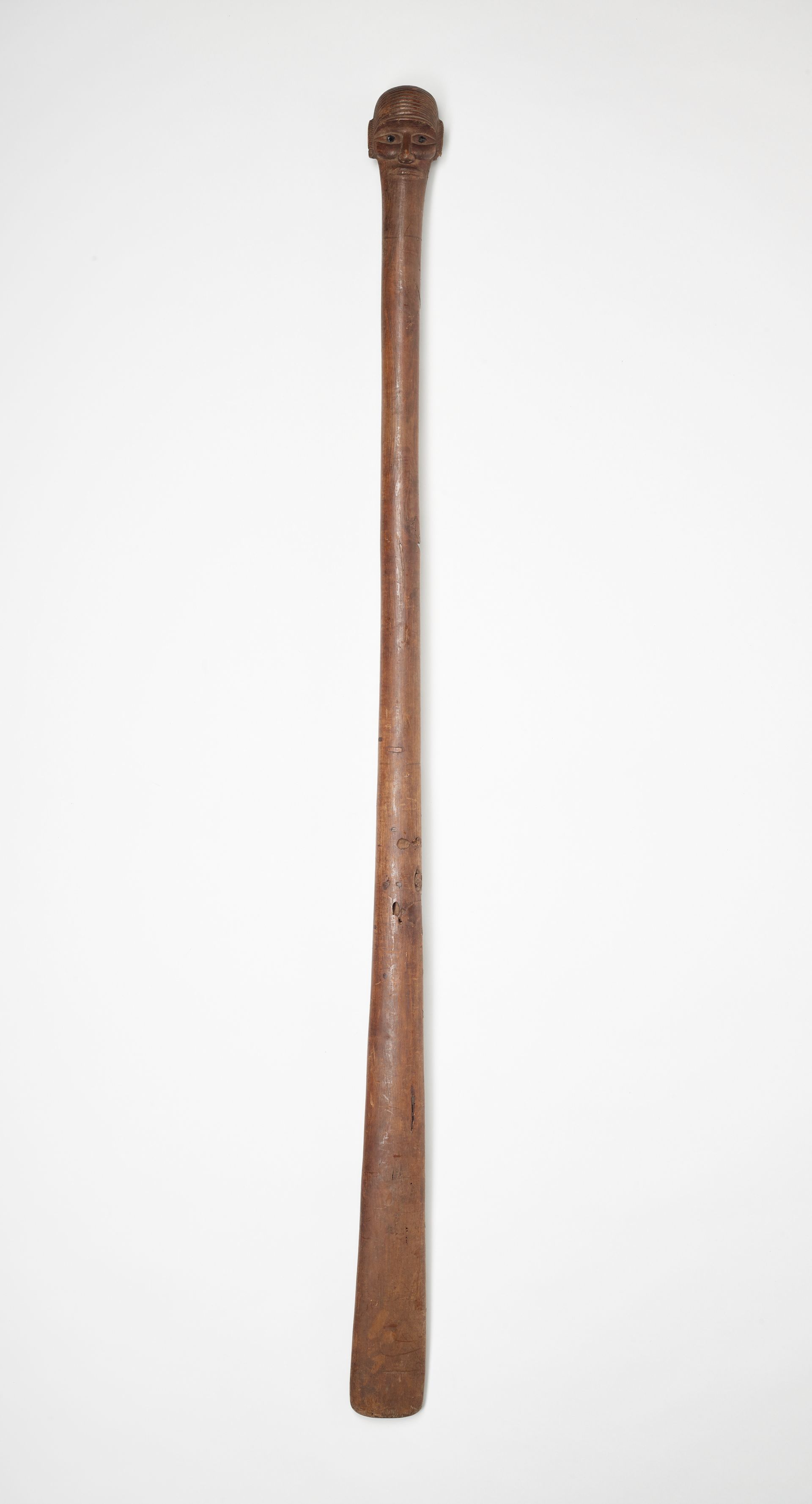
Descripción: Ua were described in the past as clubs, among other things, but even if a use as a weapon was not ruled out, it was primarily a insignia of high rank. At the upper end of the staff is a carved double face, the eyes of which were made of obsidian. The staff has numerous historical repairs by wood inlays. (Text: Ulrich Menter)
Photograph of Ua, Stuttgart — 4567